
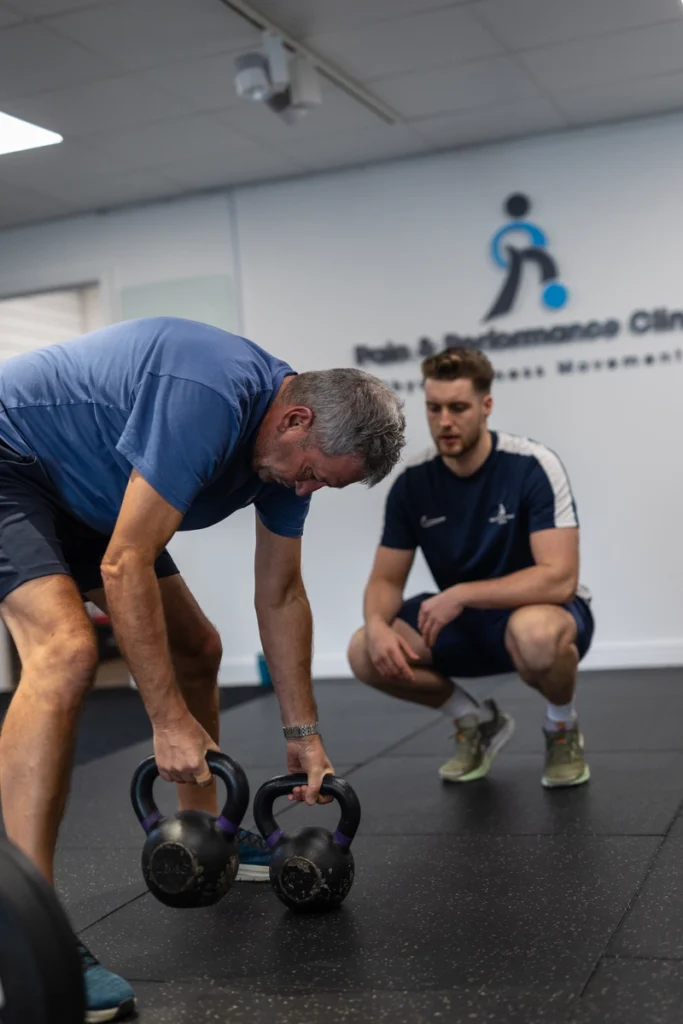
Groin Injuries can be incredibly frustrating for people. Groin injuries often happen with overload when the tissues are unable to cope with the demands placed on them. Often there is no specific pull or tear but gradually you become sore on the inside of your groin.
It can even be sore when coughing, sneezing, or sitting up in bed. This is because more than one area can be affected with this. It is not just your groin on the inside of your leg. Your hip flexor or abdominal muscles can also be affected for example. As time goes on usually more than one structure becomes affected.
Often, we can get by or carry on training with groin pain. It might be very sore after one training session, then after a day or two of recovery it settles down a bit and we feel ok to train again. However, it’s very sore again after the next session. The pain hangs around and can affect your running pace, ability to twist and turn etc.
When you look back you may not have been able to train properly for weeks. Your performance can be drastically affected.
Rest, stretching and foam rolling does not help this condition. Generic strengthening exercises are not enough for this condition. They will need to be in your program but what you often need is a very specific plan for you. That plan can vary whether it is more abdominal related, groin related, hip flexor related. You need to be properly assessed and given a specific plan for you to work on diligently at home.
Often after the first few weeks of rehab you will not see a huge reduction in pain. However, putting the work in will allow your strength and function to increase and then your pain will reduce.
This condition is one we have a lot of experience and success with here in the clinic. So, if this is an issue you are currently experiencing, get in touch and we will be happy to help you get back to your best.
Groin pain is an injury that will generally niggle away at you for a little while. It Also requires more specific training and general exercise won’t always help groin pain. Thankfully though this does not mean you need surgery. Groin pain/groin injuries generally have very good outcomes with conservative management.
Conservative management means physio therapy as opposed to surgery. Sometimes this conservative management can include anti-inflammatory medication or injections but this can be discussed with your physio.
The two most important things with groin injuries are;
To make sure you have full faith in your physio as groins need specific strengthening and also controlled return to running/playing if you are an athlete.
And, To have patience. Often after healing has completed there is still pain present in the area. An injured area can be more sensitive to pain and this goes especially for the groin.
The best way to determine how well your injury is progressing is not by constantly looking at pain levels but instead it’s thinking, am I doing more? If the pain hasn’t gone up but you are able to do more than this is progress and it’s the positive you should be focusing on.
Groin pain can be one of those lingering injuries that will not resolve over time if we do not target it directly with specific exercises. Generic strengthening exercises will not get rid of the issue.
Specifically loading the involved structures is key with groin pain whether that be the groin, hip flexor, abdominals or lower back. If we ignore this condition over a long period of time, we may start to feel pain in different structures around the pelvis.
We and our partners, including Google, use cookies and personal data to analyse traffic and for ads personalisation and measurement. You can accept, reject or choose which cookies to allow. Privacy Policy • Cookie Policy • Terms & Conditions • Google Privacy
We use cookies to help you navigate efficiently and perform certain functions. You can choose which categories to allow below. Cookies categorised as Necessary are always active.
We also use third-party cookies for analytics and advertising. These are only stored with your consent. You can update or withdraw consent at any time via the cookie icon at the bottom-left. This site operates under UK GDPR, the Data Protection Act 2018, and the Privacy and Electronic Communications Regulations (PECR). Cookie Policy • Privacy Policy
Necessary cookies are required for core site features including security, network management, and consent storage.
| Cookie | Duration | Description |
|---|---|---|
hmdg_cookie_consent | 180 days | Stores your cookie consent preferences. |
PHPSESSID | Session | WordPress session identifier. |
wordpress_logged_in_* | Session | WordPress login authentication. |
Functional cookies enable enhanced features such as live chat and remembering preferences.
| Cookie | Duration | Description |
|---|---|---|
wp-settings-* | 1 year | Stores user interface preferences. |
Analytics cookies help us understand visitor behaviour. Controls analytics_storage for Google Analytics 4.
| Cookie | Duration | Description |
|---|---|---|
_ga | 2 years | Google Analytics — distinguishes users. |
_ga_* | 2 years | Google Analytics 4 — session persistence. |
_gid | 24 hours | Google Analytics — distinguishes users. |
_gat | 1 minute | Google Analytics — throttles request rate. |
Performance cookies collect aggregate, anonymous data about site performance.
| Cookie | Duration | Description |
|---|---|---|
_gat_gtag_* | 1 minute | Google Tag Manager — rate throttle. |
Marketing cookies track visits to deliver relevant ads. Controls ad_storage, ad_user_data, and ad_personalization.
| Cookie | Duration | Description |
|---|---|---|
_gcl_au | 90 days | Google Ads — conversion tracking. |
_gcl_aw | 90 days | Google Ads — click attribution. |
_gac_* | 90 days | Google Ads — campaign information. |
IDE | 1 year | Google DoubleClick — ad targeting. |
Powered by HMDG • Cookie Policy